This is the third and last thread in the series of my takeaways from the SCG Sustainable Development Symposium. I am glad that I have continued writing on it for three weeks in a row. I began the series with the policy-level perspective, followed by a story on a large-scale community project. Cliché as it may sound, this part will be about the next generation.
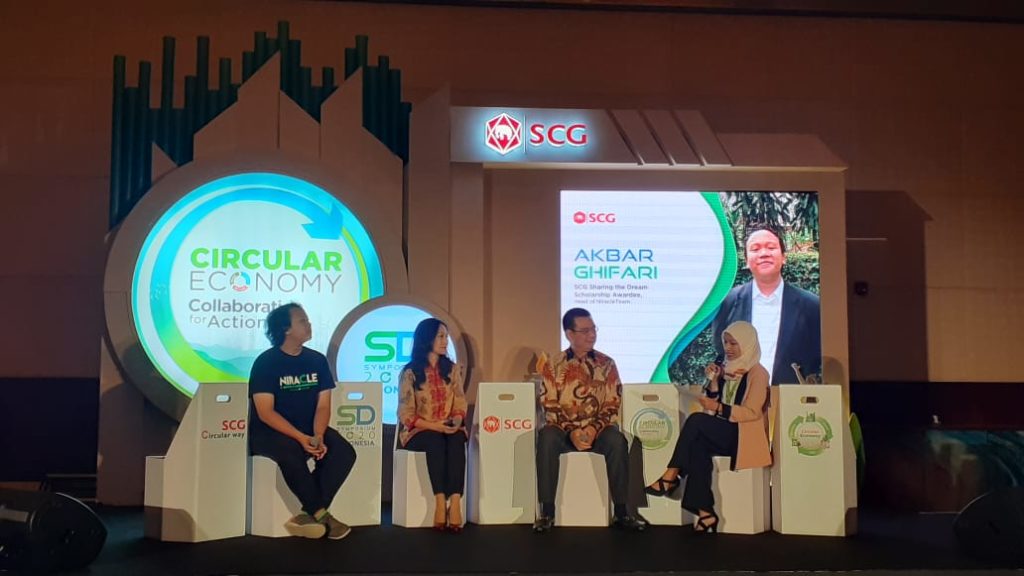
I am not trying to promote SCG but I have to elaborate on this a bit to give you some background. Every year, SCG Indonesia, as part of their CSR initiatives, grants a number of scholarships at various levels. Akbar Ghifari first received a scholarship when he was in high school. At university, he applied for a second scholarship from SCG, this time the scholarship was for him to participate in seminars and training camps that groom young adults to pay more attention to social issues. Akbar had an opportunity to present a project with an aim of providing solutions to social problems. Akbar’s focus has been on fabric waste.
The majority of villagers of Padasuka, Soreang, Bandung are in professional textile industry, 70% to be more precise. Tonnes of textile waste are produced ,and to a large extent, burned every year. Akbar saw this as a problem that needed solving. He thought there should be a better way to reduce tonnes of plastic waste. So he began the Niracle’s first collaborative project, along with 9 other SCG scholars by adding values or produce new products from textile waste.
Small patches of left-over cloth have since been made into decorative roses, pouches, and bags which are then sold. As earnings of the villagers increase, the group has continued to expand their reach even further.
It is a small endeavour, no doubt, but a significant and novel step. Making a product from waste may not be new. But the fact that a group of young adults initiating the project by convincing villagers and working with the community as a team is heartening and admirable. After a while, Akbar and his mates were successful in weaving the new routine of making use of leftover fabrics into the life of villagers.
I am writing about Akbar and his group, Niracle, not because of their work or their products, roses made of fabric petals and fabric pouches. I am writing to support the spirit of youth in realising the importance of waste reduction and initiating their own projects. With the proper support and encouragement, the new generation will be able to embark on projects that will solve problems created by our generation and the generations before us. They will be able to shape their own better future.
I want to see more Akbar.
Akbar Ghifari (left), representative from the Niracle, speaking as a panelist at the SCG Sustainable Development Symposium on 20 February 2020 Photo courtesy: https://www.jagatngopi.com/
This is the second post on my takeaways from the SCG Sustainable Development Symposium on 20 February 2020 in Jakarta, Indonesia. Towards the end of the Symposium, a presentation introducing Project STOP began with a short video clip of a coastal fishing community of Muncar, Banyuwangi in East Java. It showed enormous amount of plastic waste taking up the space of what should have been serene coastlines. Fishermen were seen pushing their fishing boats, through the beach of plastic, to the sea. The first thought in many people’s mind would, I guess, be along the line of irresponsible individuals not caring for the environment.
Yet, a few interviews showed that the people there did not have a choice. Waste collection system was very minimal. They had bins, but stuff in the bins went nowhere, making no difference for them where they threw plastic waste. For me, this was quite sad. It’s not that people did not know having waste next to their houses, next to the sea where they go out regularly to make a living is bad for their health and especially for their kids. But they just did not have a proper system that would take care of their waste.
This particular community did not face this problem alone. According to Project STOP, throughout Indonesia, only 45-50% of solid waste is collected. Around 1 million tonnes of waste leak into the water per year. Indonesian government has realised the problem and has made a bold and commendable move to reduce plastic waste by 70 percent. And this is where Project STOP came in.
Project STOP works with a number of organisations, local and central governments, and of course the local community to help design sustainable waste collection systems, and promote behaviour change in the areas. Project STOP is now at work in three regions in East Java and Bali.
The video at the beginning of the presentation was eye-opening to me. It illustrated how a simple supporting system like waste collection can play a big role in reducing plastic waste and marine debris.
Find out more about Project STOP at https://www.stopoceanplastics.com
I had a chance to attend the SCG Sustainable Development Symposium Indonesia 2020 last Thursday. The event was organised by Siam Cement Group (SCG), a Thai company specialising in cement production with outposts in half of ASEAN countries including Indonesia. The company is pretty well-known for its sustainable development approach. Having held the Sustainable Development (SD) Symposium in Thailand for quite a few times, the one last week was the first time outside Thailand.
I have got a few takeaways from the Symposium that rather quite fit the topic of waste management. They are interlinked but for the ease of reading (and writing about them), I am separating them into three consecutive posts. I must say from the start that I am not an expert nor do I aspire to be. Waste is a topic that I am concerned with and I feel passionate enough to write about how we manage it.
As the first in a trilogy, I want to begin by visiting the concept of Circular Economy in the aspect of waste management that goes a little further than recycling.
Most people of my generation as well as my parents’ generation are aware of recycle. We try to recycle paper, plastics, aluminium lids, you name it. And we see on some products sentences that make you feel good “this bag is made of used aluminium cans”, “this book is printed on 20% recycled paper” and I support them. They are good initiatives. Yet from one of the presentations I saw at the symposium, the process of recycle does not mean that 100% of waste will be recycled. This is where the concept of circular economy comes in.
Circular economy, according to the EllenMacArthur Foundation, is a rethinking of the economic system away from its conventional linear form, ‘a systemic shift’ that involves all stakeholders. To give you a clearer picture, in a linear economy, a product may be made from recyclable and non-recyclable materials. Some products are very difficult to separate the materials thus making it almost impossible to recycle even though many components are recyclable. With circular economy, companies (and individuals alike) need to think things through from the initial stage of product design.
On this, Mr. Vichan Tangkengsirisin, President Director of Dow Indonesia, a member of Indonesia Partnership on Plastic Waste Management (IP2WM) presented us with a good example how product design can make a difference. He mentioned that in the past the pull-tap of canned fizzy drinks were made to be disposed after opening, causing these small aluminium pieces to be mixed with other types of waste, making it difficult to separate and recycle. There came a time when fizzy drink companies decided to make the pull-tap became ‘stay-tab’, reducing the chance of small recyclable aluminium mixing with other litters.
With circular economy concept in mind, companies need to rethink their materials. Mr.Vichan stated that the evolution of packaging has resulted in food stays clean and fresh for longer. However, a good packaging that boasts such qualities requires an amalgam of materials. Different types of plastic are mixed together to create an even stronger package that withstands typhoons. The horror comes after packages are discarded. Each type of plastic has a different way of recycling. With super packaging it is almost impossible to recycle such packages.
But there is hope. The trend is converging towards having one type of material for packaging while delivering all the qualities. Some have even been used commercially.
The above examples constitute only one part of the circular economy, that is from the production side. Retail is important here. Manufactured products become consumer goods sold in retailers across the globe. It is imperative for brand owners to pitch their goods to customers well in order for the products which have been designed with recyclability in mind sell.
It then goes on to consumers and waste collection and segregation and back to manufacture which involves redesigning the products and packages again. I wish to save these for later. What I have written is basically what I picked up at the symposium last week on how the concept of circular economy plays a role in waste management that goes a little bit beyond the conventional idea of recycling. I hope you have had a good read. Till next time.
I have been travelling and can’t help but feel, after a long day, that I need to get sufficient sleep. However, I intend to honour my commitment to write at least a post a week to be publicised every Monday.
Today’s topic is on writing. I want to talk about how I develop my writing style. The short answer is through reading (a lot). A more elaborated one suggests several things that I usually look for when I read.
First of all, I look for a writing style that I like. Sounds simple. Yes, it is that simple. I simply just read to find an author whose writing resonates well with my character, personality, and experience. There are times when I just stand in front of bookshelves in a local Kinokuniya, undecided which one(s) to go for on the same topic. Eventually, I tend to opt for books that do not spray sophisticated words and terms around. But this does not mean that I prefer not to use them at all. In fact, I do believe that such words enrich our languages and improve our ability to express certain concepts and thoughts but they have their places. Spraying our writing with superfluous words and all the niceties, especially in non-fiction books, is actually defeating the purpose of writing, that is getting the message across to the intended audience.
Second, I look for the narration sequence. This is especially beneficial if you are writing a novel. Many authors write in chronological order, the order in which things happen. Many prefer switching the time back and forth between the past and the present. In Cloud Atlas, a book I am reading now, there are about six different stories set in different times yet all are connected through certain links found in the main characters. It goes from past to present to future then back from future, present and the past to close all the stories. I haven’t reached the end yet, but this is a new technique that is doing its tricks.
Third, I enjoy learning how different authors use syntaxes as well as sets of vocabulary. The way sentences are formed define the tone of that piece of writing. This is where creativity flourishes. And for me, Murakami (and his translators), has been excellent in empowering the syntaxes in his books to have an immense impact on the readers. Syntaxes in Murakami‘s books are very simple. But he (and his translators) chooses his words and their places in the sentences meticulously. Each of his work I read has never failed me in this sense.
So these are the elements I usually look for, consciously or subconsciously, when I read a book. It does help when I write. Whenever I read more, I tend to be able to write more, with ease and with more vocabulary at my disposal. In effect, I read to write. In the first few years of actively writing (after I finished high school), I tended to try to imitate a Thai writer but after a while, I think I have developed my own style of writing. Though I don’t know whether any of my friends / readers have noticed…
I came across an article on the possible impact of a school’s design on children’s education in the Monocle Forecast 2020 written by Annabelle Chapman. Most of us would think of schools as a place of uniformity. In the East especially, we can expect state schools having similar structure, grand old buildings with corridors and rectangular classrooms each featuring small desks facing a dust-full blackboard (nowadays these desks may be facing a stained whiteboard that has seen better days). The walls are sometimes filled with students’ projects that are somewhat pre-determined, pre-arranged and pre-graded.
Devoting a lot of efforts to designing a school is rare. We generally agree that kids should have good learning materials and good teachers. But we tend not to think too much when it comes to the building design. Some may even say that kids come and go and it’s probably not worth putting a lot of money and efforts in designing state-of-the-art buildings for kids who spend a few hours a day interacting with friends and teachers. And they will soon graduate.
Yes, but the time they spend at school is also their formative years. “The surrounding shapes, colours, and texture can help pupils feel at ease or inspire them to be creative”, according to the article. On this basis, several schools in Switzerland have started considering school design as a major factor towards achieving good education. A primary school in Zofingen puts colourful step-like sculptures in a drab hall. According to designers, “bright colours, engaging textures and flexible spaces support playfulness and creativity”. In terms of materials, warm and natural ones help students and teachers feel calm and focused.
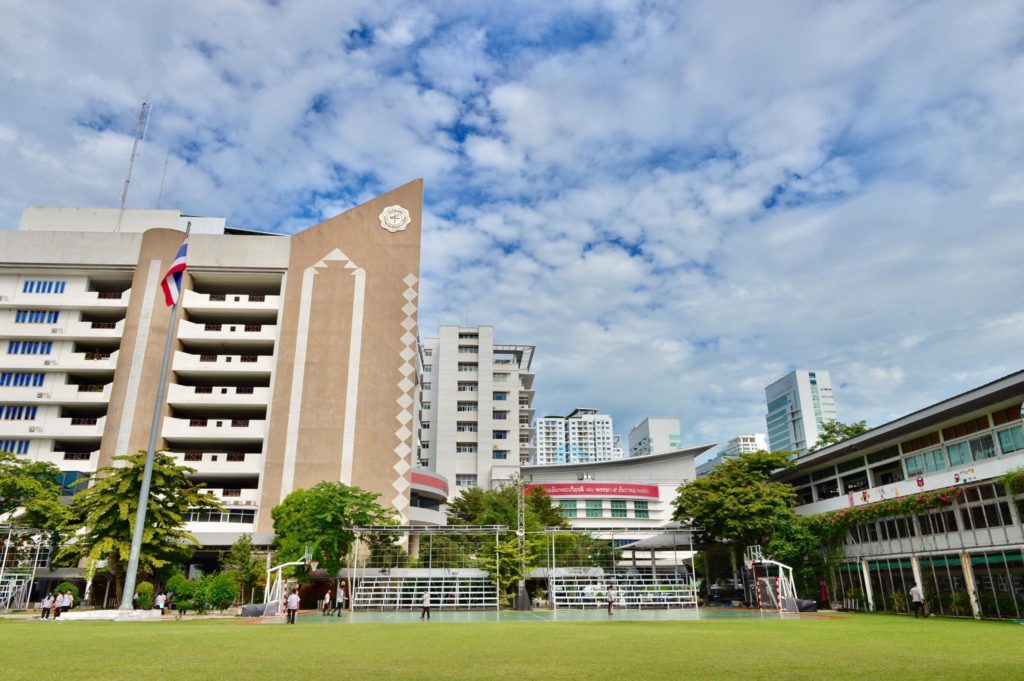
I can personally attest to the idea that good school design (and physical structure) stimulates learning experience of students. I was lucky that my school (a lab school in a university) had thought things through with most of the facilities; a curved dust-free blackboard reduces sun-glare, allowing us at the back to see the writings on the blackboard; a sound system in each classroom which only required a microphone rather than a bulky hand-held speakers most teachers at the time had to carry around; classroom windows overlooking a green neighbourhood and some nicely-built skyscrapers; and fully ventilated open-air hall that never needs air-conditioning, to name but a few. These in their entirety did foster something within me. A concept, perhaps, to think things through, to look at the big picture, and to see how things are connected.
Another important thing I got from my school was that kids were entitled to the same standard of facilities as adults. Rather than treating us as a different human class. My school built modern toilets for students. We had lifts (and later, an escalator), air-conditioning system, and food of superb quality. Things always worked and predictable. While these may sound rather materialistic, the underlining idea is that we were treated not as students but as adults living in the same community. This, along with the smooth running of the school’s physical structure complemented by several thoughtful designs had made us worry one thing less, stimulated our learning experience and contributed, unconsciously perhaps, to some of our beliefs and principles.
My alma mater Photo Credit: https://www.alleduguide.com/schoolskindergartens/curriculum-of-psm/
I am not a professional runner. Before moving to Jakarta, the furthest I ran was 10k. Weeks into my new assignment in the bustling capital of Indonesia at the beginning of 2019, my colleague inspired me to further my distance.
I have thus become a (more) regular runner. And I did two half-marathons last year with an ambition to finish my first marathon this year.
Introduction done. Let’s concentrate now on where I usually run in Jakarta. This won’t take much time don’t worry, because I have only run at two places.
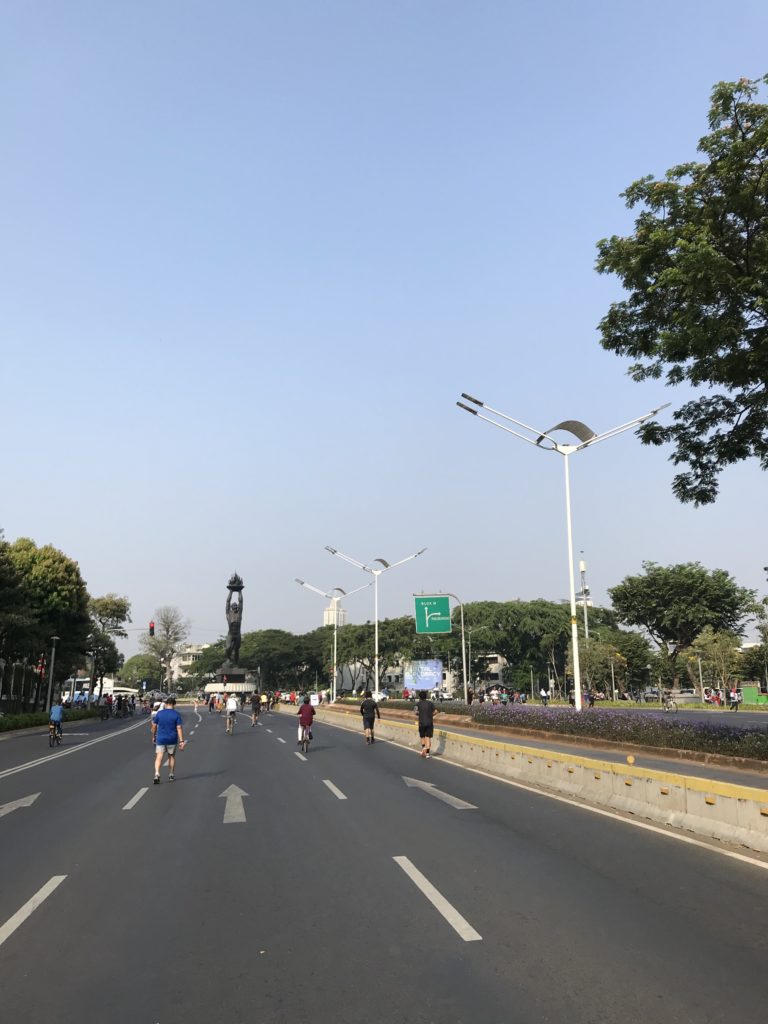
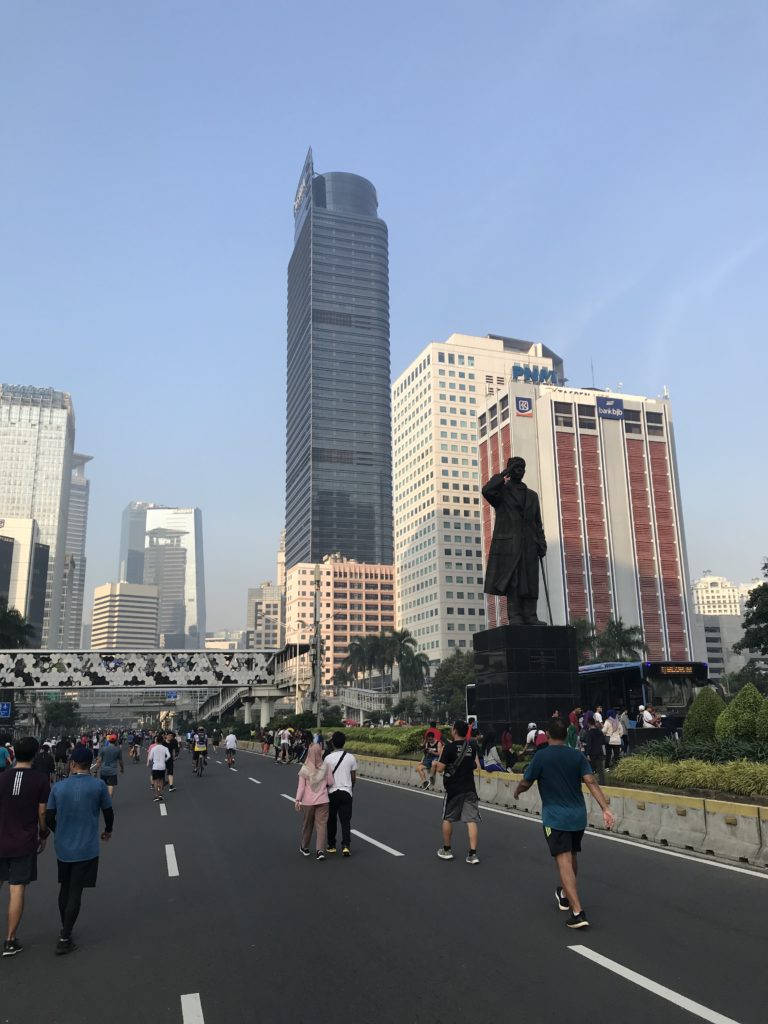
First is the Car Free Day- I refer to the car free day on Jendral Sudirman Road, the main and largest and perhaps the best-looking street in Jakarta linking the city’s north and south. The current format of Sunday Car Free Day, I believe, started in 2012. The road, with the total length of about 5 km is closed from 0600 – 1100 hrs, making it a perfect place for road-running / on-court training.
When to go: It’s held every Sunday non-stop except major holidays like the Idul Fitri / Idul Adha, New Year, so you better check https://www.infocarfreeday.net if unsure.
The time is 0600 – 1100. Many go before 0600 and run on footpath instead until the cars are gone. Depending on the season, after 0630, the sun may be quite strong and after 0730, it may become unbearable.
Why I go: There are three things I really like about Car Free Day
(1) You can keep track of your distance easily. As mentioned above, the total length of the road is approximately 5km. So if you start, like I usually do, from Patung Pemuda Membangun (known colloquially among my circle of friends as the Pizza Man – please do let me know if Indonesians also call it Pizza Man), you will reach Bundaran HI with the distance of around 4.5 km. Make a u-turn, run back to where you began and that should give you about 9-ish km. If you are training for a half-marathon or a marathon or even a 10k, this is quite a good training ground.
(2) I get motivated from seeing other people run. Through the length of the road, you will see people training for their races proudly wearing t-shirts from their previous running events, people who are dragged out of their beds by friends, and kids racing. It’s sometimes good to be reassured that it’s not just me going through this (self-made) struggle of regular trainings.
(3) You run with a view. Jenderal Sudirman road is, admittedly, very nice when there is no traffic. I quite enjoy looking at the skyscrapers along the road. And you don’t enjoy this on a weekday when you try to get through the eternal macet (traffic jam) that seems like eternity. Hence, another reason to get out of the bed early on Sunday morning.
What to take into consideration:
(1) The transport – Car Free Day, I must say, is good for those who live close to the road itself. It’s going to be quite a hassle, if you live in North Jakarta or Pondok Indah. The time you have to wake up and travel with your car to park somewhere close, I suppose, is quite costly.
(2) The weather – it is an outdoor road running route. If it rains, then the car free day will also be free of people. So check the forecast.
(3) The market – As you get closer to Bunderan HI, the great big roundabout surrounded by Grand Hyatt, Kempinski, Mandarin and Pullman, the road is full of hawkers and traders selling everything from water to travel packages. For a runner, you may want to make a u-turn before the roundabout itself as you will find it harder to run. But it’s a good place to stop to recharge yourself with some food, water and juice.
One end of the Car Free Day – Patung Pemuda Membangun or the Pizza ManRunners of all levels of seriousness around the statue of General Sudirman, a national hero. The road is named after him.
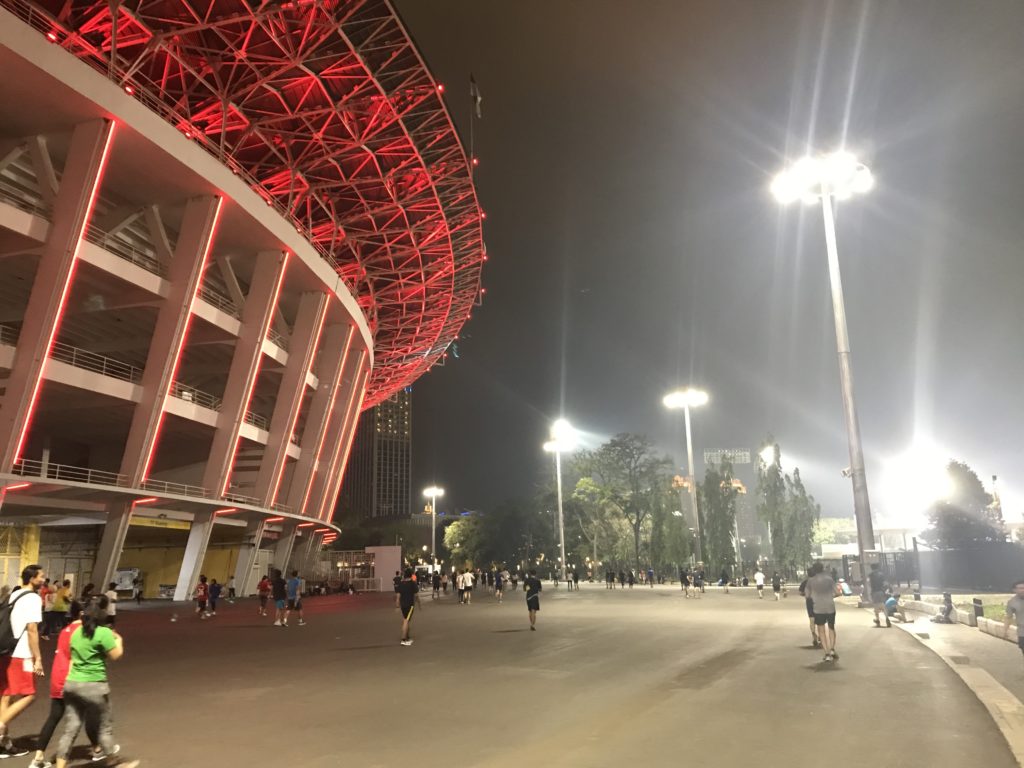
Second is Gelora Bung Karno Main Stadium – Gelora Bung Karno or GBK is Jakarta’s main sports complex situated in Senayan area. Named after Sukarno, the first president of Indonesia, the complex was first used as a venue for the 1961 Asian Games. Following major renovation, the stadium welcomed athletes and keen spectators to the 2018 Asian Games.
I suppose GBK has been a place where Jakartans go to when they want to exercise since its first day. Yet the renovation for the 2018 Asian Games was a major boost that has since motivated people to get out and about. I first ran at GBK with my Indonesian counterpart. Basically you run in a circle, around the main GBK stadium. Each round is roughly 1 km.
When to go: It opens all day from about 4-5 am and close at around 9-10 pm. (I usually go at night). That said, this is a place where Indonesians come for concerts, political rallies, and large public gatherings. So if you don’t live nearby, I suggest you check first before physically arriving here to avoid disappointment. Here is the website https://gbk.id (I also phoned them once to enquire whether the stadium had any event the following day, and it worked! The person who picked up the phone knew the schedule/request for use of the stadium.)
Here are the reasons why I go running at GBK:
(1) Parking Space – On a normal day (weekends included), you can almost always find a parking space. There are dedicated parking lots around the stadium itself. Alternatively, you can also park at some arena in the compound and walk to the stadium.
(2) The motivation – It’s slightly different from the crowd you see at the Car Free Day. There are exercise groups who frequent GBK. So you will see people doing push-ups, core training or aerobics in groups. There are a few running clubs who run around GBK on a regular basis too.
(3) Easy to keep track of the distance – each round is 1 km. So if you are practising for a marathon, you just run 30+ rounds around the main stadium. But this very fact of running in circle leads me to the points to consider.
What to consider:
(1) Circular run makes it difficult to keep your motivation high – from the very fact that you run in circle, with no clear starting / finishing points apart from your smart watch or fitbit. This makes you constantly thinking when this ordeal will end. There will be times when you think “I have run 5k already but how come my watch is showing 2.5k. Ideally, I prefer linear run as it is easier to pinpoint landmarks and (for me at least) it’s better psychologically as you know, with ease, how much you have run and the remaining distance. i.e. helping you to cheer up your internal organs and spirit.
(2) The weather – similar to the Car Free Day run, this is outdoor, so you’d better be prepared. The stadium roof does offer some shade but that’s not really enough for you to run comfortably when it rains or in the scorching sun. though given the opening times, you can actually choose to come when the weather is nice, unlike Car Free Day when the timing is more specific.
Running at GBK after sunset
That’s about it. These are the two places where I go running in Jakarta (apart from the gym). I know some expats do run at Ragunan Zoo but I haven’t explored that one yet due to the distance from my apartment to the zoo. Hope what I have written will give you a glimpse of what it is like running with the crowd in these two popular places.
This was the first book I read in 2020. Well actually, I started reading in the last few days of 2019. It was a coincidence, the way I came across this book with a seemingly dry title. I was browsing through book reviews of 2019 in the Guardian and the Financial Times. Then this one was among those featured in the FT’s article. Even though Bill Bryson was a chancellor at my university and we named the university library after him, I failed to finish a couple of his books many years ago. So I was debating with myself whether to give this one a go. After a few glances at the sample of the book, my Kindle started downloading.
The book talks about each part of our body pretty much in laymen’s words yet backed up by researches and scientific data. Bryson begins the book from the very basic then works his way in from the outside to the microbes that live in our bodies. The chapters are adorned with fascinating facts that you can definitely relate to. Trust me, more than 70% of which are the ones you learn here for the first time. Here is an example:
“Children do much better with extreme cold than with extreme heat. Because their sweat glands aren’t fully developed, they don’t sweat freely as adults do. That is in large part why so many of them die so swiftly when left in cars in warm weather.”
By linking and weaving facts and findings to real-life concerns and incidents, Bryson has successfully steer his book (very far) away from being boring and dry. I’m pretty sure you will find that about half the information in the book confirming popular beliefs while the other half denying the beliefs you have held dear with regards to your body and well-being.
I also enjoyed the stories of scientists / doctors experimenting with new medical cures and medicines. At times (or indeed most of the time), such experiments led to unfortunate loss of lives and I usually had my phone at hand ready to google some chilling surgeries just to add to the goose-bumping experience. But again, given the limited knowledge we knew of our bodies and diseases back then, each experiment brought humanity a step closer to gaining extra years of life expectancy.
So I’d recommend this book. It is fun, easy to read, yet packed with useful stuff (and facts that may be useful for pub quizzes). It is suitable for all ages except some creepy anecdotes that may need parental supervision!
Cover of the book – photo courtesy of Amazon.co.uk