
Category Archives: What I’m concerned about

Weaving their own future

This is the third and last thread in the series of my takeaways from the SCG Sustainable Development Symposium. I am glad that I have continued writing on it for three weeks in a row. I began the series with the policy-level perspective, followed by a story on a large-scale community project. Cliché as it may sound, this part will be about the next generation.

I am not trying to promote SCG but I have to elaborate on this a bit to give you some background. Every year, SCG Indonesia, as part of their CSR initiatives, grants a number of scholarships at various levels. Akbar Ghifari first received a scholarship when he was in high school. At university, he applied for a second scholarship from SCG, this time the scholarship was for him to participate in seminars and training camps that groom young adults to pay more attention to social issues. Akbar had an opportunity to present a project with an aim of providing solutions to social problems. Akbar’s focus has been on fabric waste.

The majority of villagers of Padasuka, Soreang, Bandung are in professional textile industry, 70% to be more precise. Tonnes of textile waste are produced ,and to a large extent, burned every year. Akbar saw this as a problem that needed solving. He thought there should be a better way to reduce tonnes of plastic waste. So he began the Niracle’s first collaborative project, along with 9 other SCG scholars by adding values or produce new products from textile waste.

Small patches of left-over cloth have since been made into decorative roses, pouches, and bags which are then sold. As earnings of the villagers increase, the group has continued to expand their reach even further.

It is a small endeavour, no doubt, but a significant and novel step. Making a product from waste may not be new. But the fact that a group of young adults initiating the project by convincing villagers and working with the community as a team is heartening and admirable. After a while, Akbar and his mates were successful in weaving the new routine of making use of leftover fabrics into the life of villagers.

I am writing about Akbar and his group, Niracle, not because of their work or their products, roses made of fabric petals and fabric pouches. I am writing to support the spirit of youth in realising the importance of waste reduction and initiating their own projects. With the proper support and encouragement, the new generation will be able to embark on projects that will solve problems created by our generation and the generations before us. They will be able to shape their own better future.

I want to see more Akbar.
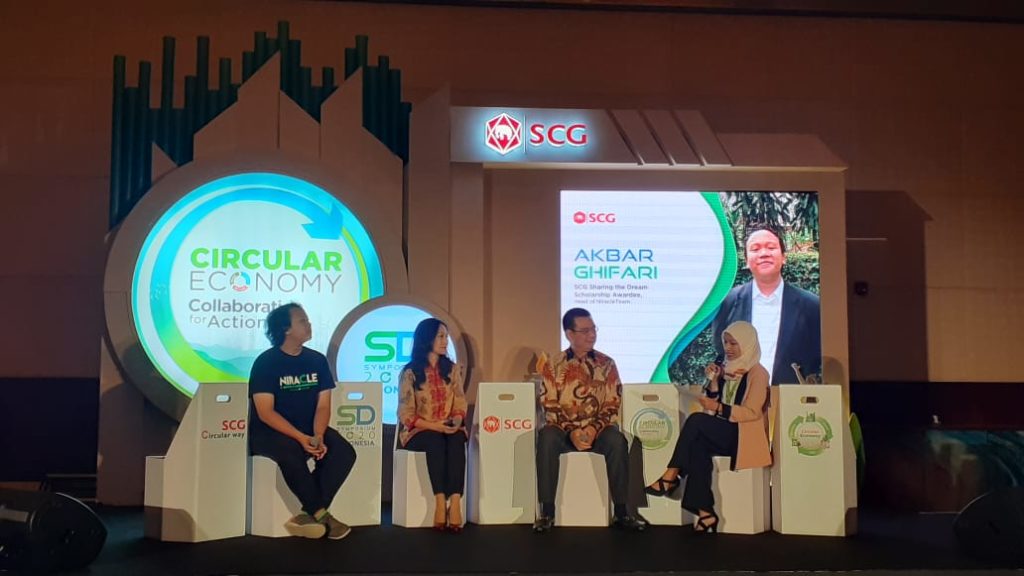
Akbar Ghifari (left), representative from the Niracle, speaking as a panelist at the
SCG Sustainable Development Symposium on 20 February 2020
Photo courtesy: https://www.jagatngopi.com/

Additional Reference: https://majalahcsr.id/niracle-berbagi-kebaikan-atasi-limbah-kain-dengan-ekonomi-sirkular/

STOP

This is the second post on my takeaways from the SCG Sustainable Development Symposium on 20 February 2020 in Jakarta, Indonesia. Towards the end of the Symposium, a presentation introducing Project STOP began with a short video clip of a coastal fishing community of Muncar, Banyuwangi in East Java. It showed enormous amount of plastic waste taking up the space of what should have been serene coastlines. Fishermen were seen pushing their fishing boats, through the beach of plastic, to the sea. The first thought in many people’s mind would, I guess, be along the line of irresponsible individuals not caring for the environment.

Yet, a few interviews showed that the people there did not have a choice. Waste collection system was very minimal. They had bins, but stuff in the bins went nowhere, making no difference for them where they threw plastic waste. For me, this was quite sad. It’s not that people did not know having waste next to their houses, next to the sea where they go out regularly to make a living is bad for their health and especially for their kids. But they just did not have a proper system that would take care of their waste.

This particular community did not face this problem alone. According to Project STOP, throughout Indonesia, only 45-50% of solid waste is collected. Around 1 million tonnes of waste leak into the water per year. Indonesian government has realised the problem and has made a bold and commendable move to reduce plastic waste by 70 percent. And this is where Project STOP came in.

Project STOP works with a number of organisations, local and central governments, and of course the local community to help design sustainable waste collection systems, and promote behaviour change in the areas. Project STOP is now at work in three regions in East Java and Bali.

The video at the beginning of the presentation was eye-opening to me. It illustrated how a simple supporting system like waste collection can play a big role in reducing plastic waste and marine debris.

Find out more about Project STOP at https://www.stopoceanplastics.com

Circular Economy: Beyond Recycling

I had a chance to attend the SCG Sustainable Development Symposium Indonesia 2020 last Thursday. The event was organised by Siam Cement Group (SCG), a Thai company specialising in cement production with outposts in half of ASEAN countries including Indonesia. The company is pretty well-known for its sustainable development approach. Having held the Sustainable Development (SD) Symposium in Thailand for quite a few times, the one last week was the first time outside Thailand.

I have got a few takeaways from the Symposium that rather quite fit the topic of waste management. They are interlinked but for the ease of reading (and writing about them), I am separating them into three consecutive posts. I must say from the start that I am not an expert nor do I aspire to be. Waste is a topic that I am concerned with and I feel passionate enough to write about how we manage it.

As the first in a trilogy, I want to begin by visiting the concept of Circular Economy in the aspect of waste management that goes a little further than recycling.

Most people of my generation as well as my parents’ generation are aware of recycle. We try to recycle paper, plastics, aluminium lids, you name it. And we see on some products sentences that make you feel good “this bag is made of used aluminium cans”, “this book is printed on 20% recycled paper” and I support them. They are good initiatives. Yet from one of the presentations I saw at the symposium, the process of recycle does not mean that 100% of waste will be recycled. This is where the concept of circular economy comes in.

Circular economy, according to the EllenMacArthur Foundation, is a rethinking of the economic system away from its conventional linear form, ‘a systemic shift’ that involves all stakeholders. To give you a clearer picture, in a linear economy, a product may be made from recyclable and non-recyclable materials. Some products are very difficult to separate the materials thus making it almost impossible to recycle even though many components are recyclable. With circular economy, companies (and individuals alike) need to think things through from the initial stage of product design.

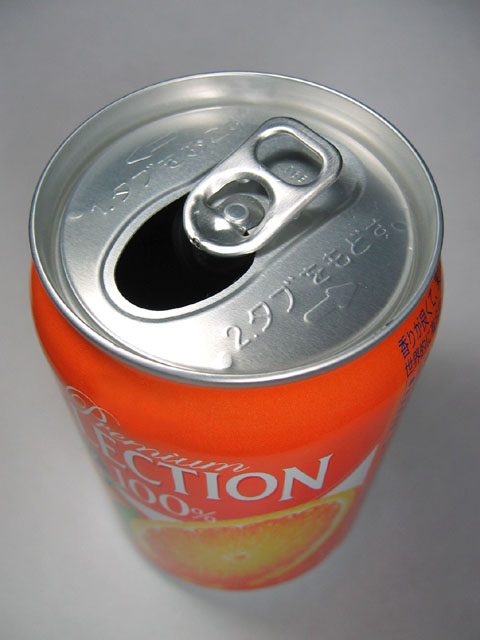
On this, Mr. Vichan Tangkengsirisin, President Director of Dow Indonesia, a member of Indonesia Partnership on Plastic Waste Management (IP2WM) presented us with a good example how product design can make a difference. He mentioned that in the past the pull-tap of canned fizzy drinks were made to be disposed after opening, causing these small aluminium pieces to be mixed with other types of waste, making it difficult to separate and recycle. There came a time when fizzy drink companies decided to make the pull-tap became ‘stay-tab’, reducing the chance of small recyclable aluminium mixing with other litters.

old-style pull tab
photo courtesy: www.wolfstad.com
a modern ‘stay-on’ tab
Photo courtesy: www.wikipedia.org


With circular economy concept in mind, companies need to rethink their materials. Mr.Vichan stated that the evolution of packaging has resulted in food stays clean and fresh for longer. However, a good packaging that boasts such qualities requires an amalgam of materials. Different types of plastic are mixed together to create an even stronger package that withstands typhoons. The horror comes after packages are discarded. Each type of plastic has a different way of recycling. With super packaging it is almost impossible to recycle such packages.

But there is hope. The trend is converging towards having one type of material for packaging while delivering all the qualities. Some have even been used commercially.

The above examples constitute only one part of the circular economy, that is from the production side. Retail is important here. Manufactured products become consumer goods sold in retailers across the globe. It is imperative for brand owners to pitch their goods to customers well in order for the products which have been designed with recyclability in mind sell.

It then goes on to consumers and waste collection and segregation and back to manufacture which involves redesigning the products and packages again. I wish to save these for later. What I have written is basically what I picked up at the symposium last week on how the concept of circular economy plays a role in waste management that goes a little bit beyond the conventional idea of recycling. I hope you have had a good read. Till next time.