Category Archives: Thoughts in English

Life in Quarantine

In mid-January, I was grateful to have a chance to go home after almost a year. While it was a brief full-of-errands kind of trip, it was a fresh break. With strict health protocols and quarantine measure in place, I knew from the start that this would be one of the experiences that would be hard to forget. So I guess it might be of relevance sharing it here too.

Pre-departure

My scheduled flight was in the second week of January. The flight ticket was twice the usual price in the pre-COVID era. That’s quite understandable though since the airlines were operating at around half (or even less) their normal capacities. Before departure, Garuda Indonesia required passengers to take a COVID-19 PCR test 72 hours before the flight. This could be done at one of the hospitals/clinics recommended by the Indonesian COVID-19 Task Force accessible through the airlines’ website.

To go to Thailand at the time, we would need a Fit-to-Fly Certificate. This was basically a result of a health check-up which was done on the same day I went for COVID-19 PCR test at one of the designated hospitals.

I would recommend everyone who needs to travel during COVID-19 pandemic to take extra care in checking all documents two or three times. Not only will you find regulations of each country different, but each airlines also have their own small prints.

With documents and negative COVID-19 result in order, I tried to minimise my contact especially going into crowded places.

Surreal Atmosphere at the Airport

While the International Terminal at Soekarno-Hatta International Airport was not considered one of the busiest terminals, but during the time of COVID-19, empty would be an understatement. That said, please leave ample time for check-in. I guess the clerk at check-in counters had to check and re-check the documents and COVID-19 results to make sure of their validity. It took around 1 hour to check myself in and get a boarding pass.

After security, things looked normal enough. Seeing planes parked at gates was quite a reassuring sight. It was a signal that people could still travel from place to place. The number of people was probably fewer than 25 percent compared to a normal day before COVID-19 hit.

Bangkok bound

On the plane, only the window seats were occupied to allow distancing among passengers. I could hear a lot of disinfectant being sprayed (which was also reassuring for me). Food was served after about an hour. The only difference was that there were more packaging materials. And melamine cups were replaced with those made from paper instead. Otherwise, the food was as tasty as it could be in the air.

Three hours later, the plane landed at Suvarnabhumi International Airport. This was another surreal experience. Last year, when I was last home, people would flock out of the airplane quickly, to be blended in with passengers coming from other countries. This time round, people waited patiently to be guided out of the airplane in order. The gates were deserted. People in half and full PPEs greeted us.

At the time, Thailand imposed 14-day quarantine to all incoming travellers. There were two types of quarantine. State quarantine was a form of hotel quarantine free of charge for Thai nationals. This would be allocated to you upon arrival so you would not be able to choose which hotel you were going to. Alternative State Quarantine (ASQ) was also a form of hotel quarantine but with greater perks. Foreigners had to book Alternative State Quarantine and pay for themselves. Thai nationals may also choose ASQ and they also had to pay for themselves too.

I preferred to know where I would stay in advance. The availability of food choice was also something that I took into consideration. So I booked the Hyatt Place Hotel on Sukhumvit Road as my ASQ.

Those who booked ASQ were separated from the queue and there were people who came to check our documents. This was efficiently done within 2-3 minutes. We then proceeded to the health screening counter where the officials would ask whether we had any COVID-19 symptoms. They would check our health documents and COVID-19 test results. Following that, we would proceed to the immigration then to luggage claim.

After getting my luggage, those who booked ASQ would leave the airport at a certain gate. The representatives from the hotel would pick us up. As for me, there was only me from my flight who would go to the hotel. So I got the van for myself. I was told that normally, there would be 2-3 people sharing the same van to the hotel.

Accommodation for the next 15 nights

In 20 minutes, I arrived at the hotel. The check-in counter was located outside the building in open air. The check-in lady was wearing plastic cap and half PPE suit. I was asked to wear shoe coverings which were made of blue plastic material at all times outside of my own room. The total stay would be 15 nights and I would only leave the hotel on the 16th day.

Following check-in, I was asked to download a few applications to track my temperature everyday. I had to add an official nurse account on LINE messaging app as a way to report my temperature. After meeting with the nurse, I was escorted by a hotel staff to my room on the 17th floor. No key card was given. I would have COVID-19 PCR test on day 5 and 12. If my first result came out negative on day 6, I would be allowed to leave the room for 40 minutes a day starting from day 7. Cleaning of the room could be done starting from day 7 too. Food would be delivered on the table in front of my room 3 times a day. I could choose and order food from a Google form. The fanciness of food depended on the hotel and the price you paid. I would consider mine a mid range.
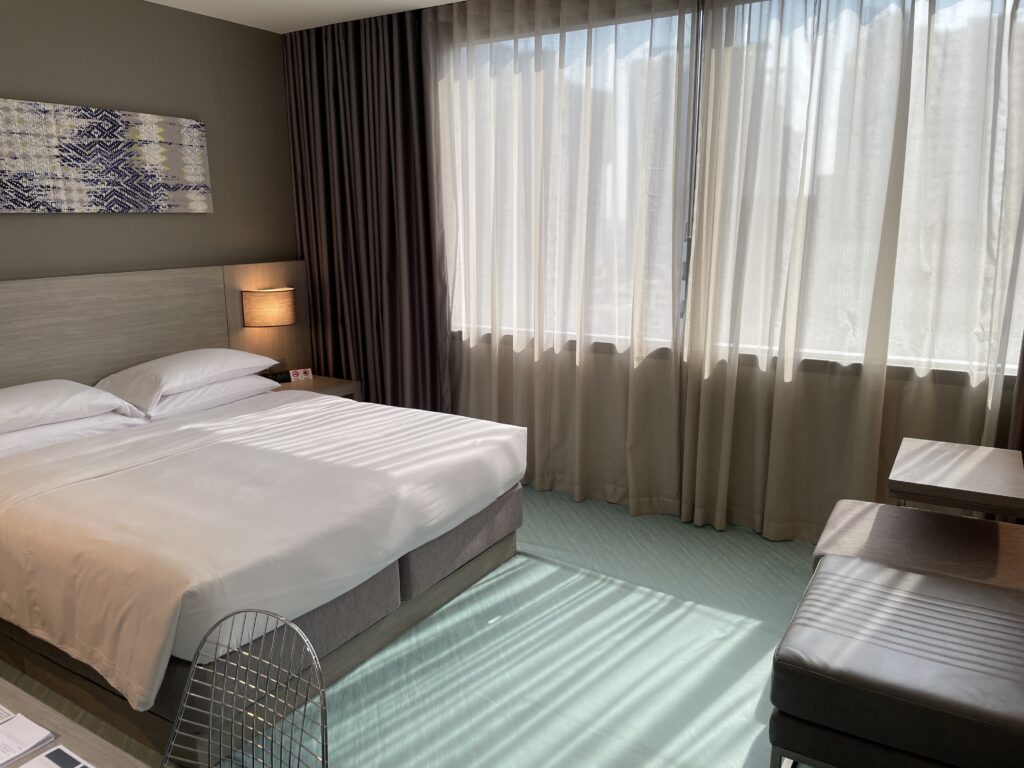
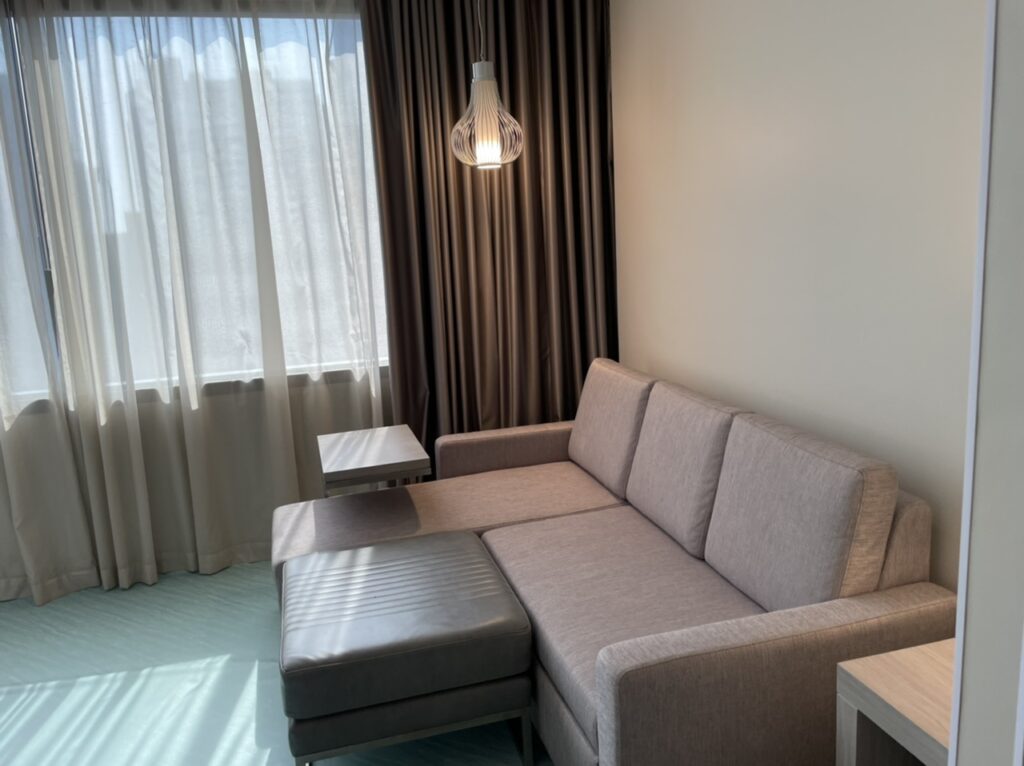
My room at the Hyatt Place Bangkok during quarantine. The carpeted floor was covered for hygiene reason.
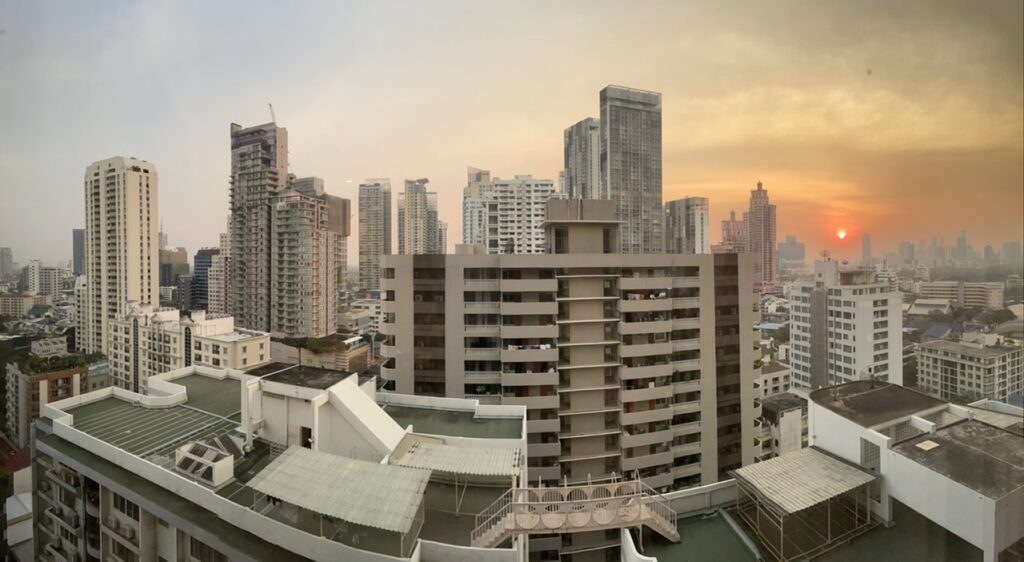
A view overlooking the heart of Sukhumvit district in Bangkok.

The overall experience was very good. The room was spotlessly clean. Mineral water was constantly refilled. There were plenty of soap and toiletries. As an introvert, I felt perfectly fine in quarantine with books to read and work to do. I really appreciate all the staff who accommodated my requests efficiently and on time.

On day 5, a nurse would contact me beforehand to let me know roughly of the time they would escort me out for the COVID-19 PCR test. When the time comes, there would be a knock at the door. Then they would take me to a separate lift up to the floor with swimming pool. The nurse at the counter would then check my name and led me to the testing site next to the pool. A screen separated me from the nurse who took my sample. Each time slot would be for one person so there was almost no chance of getting into contact with another guest who would come up for the test. I would then be led back into my room, all escorted.

On day 6, a nurse phoned me to tell the good news of the negative result. I could now book a slot to go to the rooftop for 40 minutes a day from day 7. I could also ask the housekeeping to clean my room on day 7, 10 and 13 (if I’m not mistaken). Basically I asked the housekeeping to clean when I went out to the rooftop.
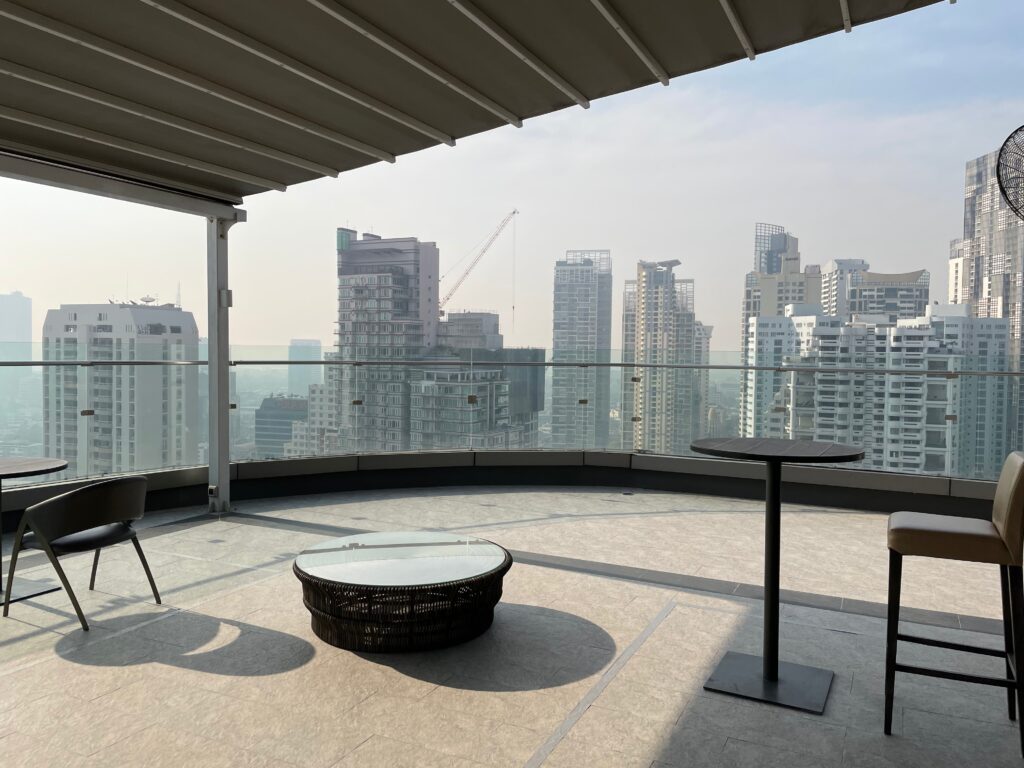
The rooftop which was normally a bar is now a designated relaxing area.

Each 40-minute slot can only accommodate 8 persons who would be asked to stay in the rectangular area marked on the floor. Mask was to be worn at all times in public area.

After 15 nights, I was released from quarantine. No doubt it was a long time but for good measure. Given the hotel’s good internet connection, I was not bored during quarantine. I also requested a yoga mat to keep up with my work out routine. Meals were provided three times a day with great punctuality. Staff were professional and they would run away when I opened the door quickly after they knocked. It gave me a lot of reassurance that they were under good management.

Before I left the hotel on the 16th day, I spoked to one of the hotel staff that I hope to see the hotel operating normally when I come back next time.

A failed attempt to cook curry from scratch…

It’s much easier to make curries at home nowadays. With the help of ready-made curry paste, adding coconut milk, meat, some vegetables and a little more seasoning and you are set. I had also been taking the advantage of this until one day when I decided to make curry paste myself, from scratch. Being in Indonesia with its well-known ‘spice islands’, also encouraged me to undertake this quest.

The first sign of failure came with me choosing to buy a wooden mortar and pestle. I have seen those stone ones and I thought that a stone mortar would be too heavy for my apartment. I learned later that the stone pestle would be better at cracking and mashing up some hard herbs and spices. It also took me forever.

I had my mind fixed on cooking Massaman curry, a mild curry with roasted peanuts. I first had to match the names of spice with pictures for I had never known what they look like. That came with more work since I had to match their English, Thai and Indonesian names together. Having done that, I went to the supermarket to get the stuff I needed.

I began by roasting those spices which would take longer time to cook namely cardamom, nutmeg, coriander seeds followed by cloves and cumin. I then put everything into the mortar, my lovely wooden mortar and began smashing all the spices. The smell was very good. I was heartened to see that maybe I was on the right track. But after half an hour, the ingredients were still not mashed. I pressed on and added some shrimp paste. After another quarter of an hour, it became a mixture, sort of, but nowhere near the smooth texture seen in the recipe. I had an idea. Since the smell is good now, probably I could just put the mixture in a blender. Ah and one more thing to add, cinnamon.

And here came the next unfortunate incident. I put whole cinnamons into the blender in the hope that the blender would grind it to become fine powder. It did not. And I should have known better that it would not. A few minutes in, some white smoke and smell emerged from behind the blender. I stopped immediately. The cinnamon still kept to its shape. I only learned later that I was supposed to put it in the curry later on to add smell or else use the ground cinnamon in the mixture. I was not supposed to put whole cinnamon in there.

With blending failed. I made do with what I had. I heated the pan. Put some coconut milk in. The trick was to stir in low heat until coconut milk gave up some oil. But that also did not happen. Before coconut milk got stuck together, I had no choice but to add the ‘half-done curry paste’. The smell was okayish but the texture was not. I must have also not paid careful attention to the amount of each spice I needed. The curry became yellow/grey-ish in colour. I put some chicken in. It looked creamy. More like yogurt chicken instead of a curry.

Half-way through, I decided that my curry would not work. So I put the chicken and the curry sauce into the oven. The Massaman curry became roasted chicken in curry sauce, well sort of.

You may ask what it tasted like. It was just okay for one-shot eating. Not to be heated up and eaten again. The sauce was a bit too thick and creamy (with all the condensed coconut milk from making curry) and the spices’ smell was too pungent while the taste was quite bland.

After the ordeal, I bought a few ready-made curry pastes and I think I am satisfied with using them for the time being. Probably in the (not so near) future, I will try doing it from scratch again, with blender (and without the whole cinnamon in there).

So this is how it looked after baking.

Lessons from Monkhood: A Decade On

Recently, I was added to a group of fellow former monks in the batch of 2010. We were ordained together as a group at Chonlapratarn Rangsarid temple on the outskirt of Bangkok before the Buddhist Lent in 2010. Time flies. It has been a full decade since I experienced the tranquility and engaged in intensive practices of Buddhism for 15 days. Before I left the temple after the period of slightly more than 2 weeks, I promised myself to continue building on the lessons I learned at the temple to become better at practicing Buddhism, free(er) from all the rituals.

A path to ordination
For Thais at least, you can be ordained as a novice or a monk depending on your age and your willingness. Those under the age of 20 can only be ordained as novices whereas those 20 or above are eligible to be ordained as monks or novices. The main difference is that a novice adopts 10 precepts or rules (dasa-sila) while a monk adopts a more disciplined life with 227 precepts. Many Thai men choose to be ordained at least once and there can be several reasons for this. Several want to take some time off their busy lives to learn more about the Buddha’s teachings and practice meditation under close guidance and supervision of senior monks. The ideal period for many is at least 3 months of the Buddhist lent. Should time be not on your side, 30, 15, and 7 days are convenient alternatives.

My father passed away when I was 19. I had a choice of becoming a novice on the day of my father’s cremation as per the prevailing custom or I could wait until I became 20 to be ordained as a monk. I chose the latter. For me, monk ordination would be a period of intensive learning of the key teachings of the Buddha with the focus on practice – how to cut yourself from all the so-called ‘earthly desires’, what are the effective ways to meditate, for example.

My high regard for ordination as an intensive Buddhism course stemmed from the time I attended the compulsory ‘Buddhism Retreat’ with my school when I was 16. The temple was founded by Panyanantha Bhikku, a senior monk who devoted his life to resist widespread superstitions that claim to be Buddhism-related. He was also close to Buddhadasa Bhikku, a well known monk who focused on practices and denied extravagances and unnecessary rituals. At the Retreat, we were barred from the outside world, staying in a forest-like temple on the outskirt of Bangkok eating two meals a day and learning to meditate. I liked the style and this became the foundation of my choice for the temple which I was to be ordained at.

I was ordained at Chonlapratarn Rangsarid temple, where Panyanantha Bhikku was the abbot. He passed away just a few years before. The new abbot used to be his close assistant. I registered to be ordained as the youngest in the 2010 Buddhist Lent batch as I only turned 20 a few months before the date of ordination.

Building Blocks

Chonlapratarn Rangsarid temple where I stayed as a monk had a predetermined set of activities for the newbie monks. I would say it was an intensive Buddhism course. This was how a day in a life of a monk looked like at the temple.

Newbie monks would wake up before 4 am, wash and head to the chanting hall. Following a half-hour chanting, we would meditate for another 15-20 minutes. We would then leave the temple to take up alms from people who live nearby. Since I was one of the youngest, my route was one of the furthest from the temple. Afterwards, we would sit around in semi circle in the temple to take up alms from those who had come to make merits at the temple. Following that, we would have breakfast at around 7-7.30. We would be given some time to tidy up our room, clean up the plates and do some washing. At around 9am, we would attend classes of Buddhism and meditation. Around eleven, we would be having lunch and this would be the last meal of the day. In the afternoon, we would go back to do more meditation. At around 3-4pm, we would be back in our rooms reading or exchanging views on certain topics related to Buddhism. Newspapers were not allowed and talks of ‘earthly topics’ were discouraged. Around 5-6pm, we would attend the assembly where our supervisor would talk to us about all sorts of things. Problems, issues or ways to improve our practices. At seven, we would have evening chanting, some more meditation before retiring to sleep at 8 pm.

A decade on

The temple’s attitude towards ordination is not for newly ordained monks to sit still during the day. Rather, the temple encourages monks to make the most of their time studying and practicing meditation which I am forever grateful for. The two-week period was clearly becoming one of the defining chapter in my life. Before leaving monkhood, I was determined to apply what I learned and continue some of the practices, especially meditation to the best of my ability.

And here I am, a decade on. I want to take this opportunity to reflect on the ideas, lessons and practices from my short but meaningful monkhood.

Free(er) from Rituals

In Thailand at least, what I take to be core values and teachings of Buddhism have been decorated with several rituals. Practiced over the years, people have stopped questioning the relations between such practices and the core values and teachings. I mentioned earlier that there is a prevailing custom for a male relative of the deceased to be ordained as a novice on the day of the cremation. I later learned that, during the time of the Buddha, there was no such thing as ordination during the funeral of the deceased with a belief to help sending off the deceased to somewhere blissful. Ordination had only one purpose which was to rid oneself of earthly desires to pursue nirvana (never to be born again).

I learned also that some rituals were nice and satisfying to have but they were not necessary. Some were even contrary to the teachings of Buddhism which encourages individuals to be attentive to their current state of mind and to be weary of extreme happiness or sadness.

Therefore, after finishing my monkhood, I was determined to try focusing my life on the core values and teachings of Buddhism and cut down on excess rituals as much as I could. I am glad that I can still hold on to that commitment, at least to a certain extent.

Meditation as a part of life

Meditation was a major part of our routine when living as monks in Chonlapratarn Rangsarid temple. Many of us may have this idea in mind. Meditation is something you do sitting down, not moving and thinking about only one thing for a certain period of time. At the temple, we were introduced to walking meditation, lying down meditation, and even meditation while engaging in activities. Also, meditation is not only about blocking all thoughts and focusing only on our breathing but it is also about being attentive to whatever thoughts and feelings that may arise at any given moment – knowing yourself at the current state of mind.

I found the meditation lessons very useful and I still practice a form of meditation every now and then. It has helped me looking after my emotions and reminding me to focus on the present.

To sum up, the period of 15 days spent being a monk was a defining period of my life. It was a different life, simple, tranquil yet full of meaning. Over the past ten years, I am glad to have had the strength to focus on the substance of Buddhism’s core values, teachings and practices rather than various forms of rituals that have been added over many generations. As an earthly layman, an excuse obviously, I have not been doing as much meditation as I had hoped. Yet, the methods I learned at the temple have continued to be an excellent guide whenever I choose to meditate. I have tried to integrate meditation into my daily routine. Building on some success, I shall continue to do so.

With mum on my ordination day
July 2010
With the statue of Panyanantha Bhikku, a highly regarded monk who was the former abbot at the temple

The strength of a Jade: a tribute to my late grandmother

It has been almost two weeks since I learned of my paternal grandmother’s passing. A second-generation Chinese originally from Southern China, her Thai name ‘Yookfa’ or ‘Yok Fa’ means ‘jade from the sky’. I wish to devote this post to the memories of my late grandmother, my very own jade lady.

One of the qualities of a jade is its strength. And this had also been a character of my grandmother. She had shown remarkable strength and resilience to the tough episodes throughout 86 years of her life.

Born to a Chinese immigrant family, her childhood was not easy. It was an episode of struggle to make ends meet. Her family could only afford to send her to a kindergarten. She left school unable to read or write and remained so until the end. She spoke Hakka at home while learning to speak Thai with Chinese accent to others.

When she reached adolescent, in line with the social norm and immigrant Chinese sub-culture at the time, her family told her that she would be married to a guy several years senior, also from a Hakka Chinese family. The guy would become my grandfather.

At a very young age and pregnant with the first child, she had to take up responsibility of feeding workers of an orange plantation which belonged to my grandfather’s family. My grandparents had eight children altogether. The burden of raising eight children, cooking for plantation workers, and looking after the household fell on her shoulders. My dad had also recalled that at the time, it was very difficult to keep the children well fed. There were times when priority of having chunks of meat or delicious desserts had to be given to the younger siblings. The toll of her hard work would befall her health when she later suffered from a chronic hunchback. Despite these, she managed to send all her children to university.

When our family’s small business was badly affected by the Asian financial crisis of 1997-1998, my grandmother continued to be a beacon of hope and encouragement for everyone. Not long after, she lost her granddaughter (my cousin) in a fire that burned down my uncle’s home. Then my uncle was hit by stroke, becoming almost paralysed that he has needed almost constant care.

In 2009, the sudden passing of my dad must have brought much grief to her as he was the first of her children to pass away. Not long after, my grandfather, her lifelong husband, departed this world also suddenly. Yet she embrace the sorrow as these were facts of life and continued to stay strong for the living.

Despite the chronic hunchback and a heart bypass surgery, she had been an active and healthy lady. Her inability to read and write did not stop her from acquiring knowledge. Only a few weeks ago, we talked on the phone and she would have a series of up-to-date information on how to reduce the risks of COVID-19 infection.

Throughout the years, I have learned a lot from witnessing the strength of heart found in the character of my grandmother. She is not with us anymore but her strong spirit lives on.

I look up at the night sky. There is a bright sparkle, from a beautiful jade.

On Behavioural Economics

I have just finished reading two books on behavioural economics, a topic that I have been interested in for some time but more so during the COVID-19 pandemic. Many of us who follow economics may have adhered to the notion of rational human beings as the basis for all economic principles. Every decision an economic agent, i.e. every one of us, makes is a carefully calculated one based on the information one has at the moment. However, according to Behavioural Economics: A Very Short Introduction, in real life, divergence from this appears more too often. “Our decisions are affected by social and psychological influences, as well as a rational calculation of benefits and costs” (Baddeley, 2017). Decision to buy, for example, does not follow the incentives of price and quality. We are often influenced by a number of factors. The availability factor – the information or memory one can quickly draw – has guided many of our decisions. You may know friends or relatives who are weary about going on a plane because of the vivid headlines on plane crashes even though air travel is, as data suggests, one of the safest ways to travel. We are also reluctant to move beyond our default options in a number of things ranging from installation of computer softwares to retirement plans. Time and time again, we decide based on certain reference points. When you are looking for a television set and found out that three of your friends have recently bought one each for USD500, you are likely to be prepared to pay roughly similar amount while in fact you can get it much cheaper.

Turning to COVID-19, several analyses have concurred that some of the most successful measures to control the virus require a high degree of localised efforts. This, together with the fact that the front line of the fight against any disease lies with each individual person, makes it even more useful to include some behavioural economics data such as how people in an area respond to an outbreak of a disease. What influence people’s decision to leave home and see doctors. Even food-buying behaviour may also be relevant.

Once the data is gathered, policymakers can employ some ‘nudges’. According to Thaler and Sunstein, a ‘nudge’ is a choice architecture that influences people’s behaviours but does not prohibit people from choosing otherwise. Since behavioural economists argue that people tend to exert their inertia. They tend to stick to default options. If governments/local authorities make these default options something that would be good for their health, a small change can lead to satisfying results in disease control. Hence, application of behavioural economics can become an effective tool to help local governments decide policies and measures that are effective and appropriate to respective communities. Having gone through the peaks, many governments can still use information on people’s economic behaviour to design and implement economic recovery plans.

Behavioural economics seems to me to be a very interesting field which opens up ways to see and solve problems from different perspectives. It is certainly something that I wish to continue reading on.

Renewable hope on renewable energy

When I was a kid, solar energy seemed to be many years off from being put into full commercialisation. It looked novel but could produce only a meagre amount of electricity compared to other forms of energy raw materials such as coal and oil. Yet the latter are fossil fuels which are the source of pollution and greenhouse gases that have had detrimental effects on the climate. To reduce greenhouse gases, we have all come to agree that it is almost impossible to ask billions of the world population to alter their behaviours. Given the continued increase of the world population and the growth (minus COVID-19) of the emerging economies, demand for energy will not fall. Thus, there has been some convergence internationally that the way out is to develop renewable sources of energy which do not pollute the air and give out greenhouse gases.

Over the years, we have seen continued efforts to produce solar cells on an industrial scale. Several countries started allowing private entities with solar cells to sell and distribute the excess solar energy produced on their rooftops to the national grids. Domestic hot water began to be powered by rooftop solar cells. But these examples were tiny. We could not have achieved the goals of reducing fossil fuels at that rate.

However, the hope has been renewed. In last week’s edition of the Economist, the article on solar energy is heartening. At present, in Britain, solar energy represents almost 30% of the UK’s electricity supply. This is a sizeable proportion. When I was a student in the UK about ten years ago, if I’m not mistaken, the figure for renewable energy (with solar energy included) was in the range of 20% of the total electricity supply. While one needs to be aware of the caveat that the almost 30% occurred on a day when there was a decline in demand and thus there was lower-than-usual demand for electricity produced from coal and gas, what it tells us is that solar energy is becoming more mainstream. The article also provides some light on how to improve efficiency of solar cells even further by delving into the intricacies of technical details.

The same edition of the Economist also suggests something that interests me. During periods of lockdown in many countries, there were accounts of clear blue skies signifying low level of pollution in large cities across the world. Yet one cannot deny the devastating economic impact from COVID-19. Millions of people have been out of jobs and many more will join in the next few weeks. The way to alleviate this, the Economist suggests, is by refocusing some priorities at the policy level and turn those who are out of jobs to help making renewable energy such as solar power more effective and efficient. This can be done by retraining some workers. If this is successful, we will probably be able to shorten the time it takes for renewable energy to take up the majority of electricity supply.

Thus a renewable hope on renewable energy.

A Digital Minimalist?

I have read this year’s much recommended book “Digital Minimalism” by Carl Newport last week. I have found the book crisp, practical and easy to read. Here are some of my views after reading it.

Let me start by way of introducing the gist of the book. Newport mentions very early on that he is encouraging a philosophy of “Digital Minimalism“. The idea behind this is not new, he says. Many people understand that too much time spent on social media is not good for our actual social health and the greater social fabric. However, many try the so-called ‘social media detox’ and have found that it does not work. With the carefully engineered algorithms by big tech companies behind social media, Newport reiterates, they will want you to spend as much time as possible swiping and staring at the screen. It is extremely difficult to refocus your behaviour simply with occasional ‘social media detox’. Instead, he proposes that we should (1) stop using every non-essential use of new technologies including social media altogether for 30 days; (2) during that period, we will need to find activities that provide us with values and bring us close to life goals/targets; and then (3) we will have to plan with ourselves how best to reintroduce certain bits of new technology into our lives so that such technology is truly beneficial. He then goes on to mention several examples that we can apply when trying to adopt this philosophy of “Digital Minimalism”.

First and foremost, I agree with the crux of this philosophy. I am sure many of my dear readers also share the same understanding that there is so much going on behind the benign interface of social media applications. We all know that the next minute after you leave a social media application to search for a hotel for your next trip (after the COVID-19 pandemic eases of course), you will find several advertisements of hotels in that particular area popping up like mushrooms. So we will need to be strong in not letting new technologies control and manipulate you (too much). To this end, I fully agree with how digital minimalists regard new technologies.

“Digital minimalists see new technologies as tools to be used to support things they deeply value—not as sources of value themselves.”
Newport, Cal. Digital Minimalism (p. 252).

The next thing I agree with is that we need to find what we deeply value. What are our life plans. When we think hard about these, then we will be able to gear our use of new technology to effectively bring us closer to those.

I feel a bit uncomfortable however with the implicit message that seems to strike and single out social media and their users. The impression I have from reading the book is that long period of using social media equals compulsive use. I totally agree that compulsive use of any kind can be detrimental to your health, values and life goals. But this applies across the board, to TV addiction, video games, and other activities be it analog or digital. For me, compulsive use to the point of addiction to something that will prevent you from doing the things you deeply value or contributing to your life goals is not good. Put another way, we should not simply adopt everything that is new in our lives without thinking about what values they give us and how best to extract the benefits from them.

As I said, I share the view that new technologies or indeed any technologies should be seen as tools to support my values and life goals. I do not know if I can be called a digital minimalist since I would regard myself as a moderate user yet I am being careful to ensure that technologies are there to support me and not the other way around. I might have contributed to their profits. But this is a byproduct and the cost I am willing to pay to continue supporting my values and life goals.

With this thinking, I have adopted a variant of digital minimalism for some time. I must say though that this came with time. When I was younger (and at university), I also procrastinated for hours on Facebook. The article that made me rethink my daily dose of social media which I still refer to from time to time is the one by Charles Chu on Quartz. It basically tells you that without spending time compulsively swiping on social media and other addictive activities, you will have time to read at least 200 books. This prompted me to think hard about my core values, what are my goals, what I want to achieve by the end of the year, what activities I wished I had time to do more, and how would I restructure my time and best reap the benefits of new technologies I had at hand. At the end of last year to set my reading goal this year to 50. I am devoting more time to keeping my blog active and finishing my novel. I am picking up on long-distance running and taking more care on my body since a senior colleague of mine once said that you have to get into shape by 30!

Hence, I now use Facebook and Instagram to keep track with my friends and families but perhaps not more than 10-15 minutes everyday for that purpose. I go to Twitter at various intervals during the day to take in some thoughts (and memes) by people I follow. I still communicate a moderate amount through these channels. For me, it’s also good to get some feedback on your cooking or practice some creativity at hashtagging. And I agree, sometimes I am there just for fun. But that is part of my core value. To lead a balanced life. (but I also constantly remind myself that I do not overusing social media purely for pleasure purposes…)

Having read the book, I find quite a few examples Newport gives to support a healthy social life very useful. One of them is to find “conversation office hours”. Newport mentions that he got this from an executive in Silicon Valley who sets aside 5.30pm as the time he will always be available for phone calls. Those who call will not need to schedule beforehand. It gives the caller some comfort, knowing that they will not be disturbing him. So Newport suggests we do the same; setting a conversation office hours at certain time in a day and promote this to those in your inner circle that you would like to have conversation with. I am now setting one up myself.

To conclude, I like the book and I share the philosophy of “Digital Minimalism“. There are quite a few practical (and proven) guidance and examples that we can adopt and follow to ensure that the way we use new technologies contribute to a healthy lifestyle, our deeply held values, and, if I may add, our life goals. While I understand why the book has a tendency to strike social media in particular, I would urge my dear readers to apply this philosophy across the board to include other activities that might be addictive and induce compulsive use. See if they are supporting or contributing to your values and goals. If not, then maybe it might worth a little readjustment.

Plants and Me

I like plants. Plants present me with a certain symbol of growth and life. From a young age, I have been amazed at how a small seed, plucked into some soil, could grow into a mung bean tree. And my success sort of stopped at that. Despite attempts to grow different kinds of plant, to my mother’s dismay of bringing dirty soil to our apartment knowing that my little garden would be abandoned and the task of cleaning up left to her, I have never been successful at keeping them.

A few days ago, I decided to order two succulents from the internet. Yes, I just ordered plants to be transported to my apartment lobby through the internet. And this is where the motivation to write an article on plants began. Come to think about it, I have many imprinting pieces of memory about plants. This article will revolve around my various encounters with and thoughts about plants at different stages in life with the hope that I will not fail this time round.

The Childhood Lessons

  • One of the first practical lessons about nature was growing beansprouts. We were given several beans to start with and some wet tissue papers. It was such a life-changing experience for me. As a kid, it was wonderful to see a new life growing from a tiny seed/bean. We were then taught to put the different seeds and beans into soil to learn that some plants take longer to grow. Then things got harder and my skills plummeted. Apart from beans (which do not need any effort to make them grow), I don’t think I had been successful in any other plants. As a homework, I was tasked to grow jasmine (not from scratch but from a blooming jasmine (tree?)). After a while, leaves started to fall and no more flowers were to be seen. I should probably have taken heed of that lurking omen that I did not have a green thumb.
  • In science lessons, I was introduced to the concept of oxygen and carbondioxide. At this point, you can probably guess what happened. I learned that plants give out oxygen during the day and emit carbondioxide which is not good for us to breathe during the night. This concept stuck until well into my twenties. When I was in the UK for my university, despite the urge to grow a plant, I did not dare to do it out of fear that I would suffocate at night. I only learned that the CO2 amount that plants emit is minimal as long as I don’t grow mangoes in my tiny unit when I started working at 25 years of age.

Vegetables in my own backyard

  • Despite my unsuccessful attempts at growing plants when I was a kid, I was still confident that it was only because I was too ambitious. Every flower is difficult to grow. This is what I kept telling myself. Herbs and vegetables might work. Since one of my favourite dishes is stir-fried pork/chicken with basil, I decided to grow basil in the house I shared with my friends at university in the UK (not in my room of course! the tree would make me suffocate!). Some of you may have seen the ready-potted basil sold in supermarkets like Sainsbury’s. I bought one of those. I cut the first few leaves to cook and was so happy that I would not need to buy basil leaves ever. I continued to water it but no leaves grew back. I kept the basil pot at the windowsill near the kitchen. I was in Durham at the time. I did what most Brits do. I blamed the weather! The wind was just too strong and the sun was no where to be seen for 360 days a year. So I abandoned the basil experiment.
  • After I finished my studies and came back to Bangkok in 2014, the idea of growing my own vegetables reemerged. This time, I was told that nothing could go wrong with growing morning glory. So I brought home some soil and morning glory seeds. I put the pot on top of the air-conditioner’s compressor on my tiny balcony. It took only a few days for morning glory shoots to be seen above the soil. I was very happy. Yet, they stopped growing. They stopped at the height of about 4-5 inches. I thought to myself, ‘well, maybe they did not have enough sun since there was another medium-rise condominium next to mine. Also, the trembling AC compressor was not conducive to plants. Another failure.

Starting afresh, plants for aesthetic purpose

  • Now this bullet is connected to the revelation that one can grow plants indoor. Special mention needs to go to my supervisor at work, without whom, I would have continued to resist having plants in my room. Having failed at various kinds of plant in the past, I resolved to grow cactus. I bought two from a market one day. One for me and one for my colleague (who is now my girlfriend). Cactus for me is probably the most fool-proof plant in the world. You can go wrong with morning glory but you really can’t go wrong with cactuses. But I did. Both plants started shedding yellow leaves/spikes. And they were slowly giving up. But then, maybe they did not have enough natural sunlight.
  • So here I am. In Jakarta, my unit has a lot of sunlight especially in the morning. A colleague asked me a couple of weeks ago where could she find decorative plants in Jakarta. That gave me the inspiration of getting plants for myself. To my surprise, they sell them online. I have never thought of buying plants online before. After payment, I was excited to think how they would transport my plants (yes I bought two). It turned out that the shops were really good at this. The pot and soil were packed separately. Each plant was covered with tissue paper inside a box with protective wrappings.
    I put them on the windowsill, with a lot of sunlight. I even looked up how to take care of them this time. I resist giving them names for now. I hope they will survive.

And I will update you, my dear readers, on this.

What’s next for tourism?

I have recently listened to several podcast episodes by The Standard, an online news platform in Thailand. Its editor-in-chief, “Ken” Nakarin Wanakijpaibul, has been interviewing key persons in various industries and sectors on the so-called ‘new normal’. We have been hearing this term ever more often now and you can perhaps guess the now-cliché theme here: workplace transformation, online shopping becoming more prevalent, and people not hanging out in groups. From this general picture, each podcast episode offers some sector/industry-specific assessments of the effects of COVID-19 outbreak in the medium and longer terms.

Among the different sectors and industries, I wish to draw your attention to the airlines and tourism industries first. This is because tourism is one of the lifelines of Thai economy, amounting to roughly 17% of our GDP. One cannot talk about tourism without discussing airlines since they are very closely connected and both industries have been hit extremely hard. I think it is also fair to give them due priority since they were the first to take a hit and will likely be the last to recover.

Ken went to talk to Mr. Tassapon Bijleveld, Executive Chairman of Asia Aviation Plc. or the parent company of Thai AirAsia, and Mr. Poomkit Raktaengam, President of Phuket Tourist Association. The episodes of the podcast can be followed by clicking on the names of each guest. I have to say upfront also that by writing this article, I am not aligning my thoughts with any of the two gentlemen. There are points that I agree and there are also points that I am not so sure about.

What does “new normal” mean for the airlines and tourism industries?

So let us begin with the term “new normal” / “new norm” or whichever name we call it. Mr. Poomkit suggests that in the tourism industry, you may want to divide the new normal into demand and supply sides. In general, we may not see a big change, not in the short term anyway, of new normal in the demand side. The reason is that after a long period of lock-down in one form or another, people will still want to travel. They will need vacation. That said, the supply side is not going to be the same, at least until stock of vaccines or effective cure is readily available. We have seen efforts to gradually ease up the lock down measures in a number of countries. While the easing up differs from country to country, the general rule of thumb is to do it in stages. Businesses and governments share the same objective of not having an uncontrolled second or third wave of infection. Should that happen, businesses may be forced to close again and they understandably dread that scenario. Entrepreneurs have thus adopted a number of measures boiled down to checklists to prevent infection. This is the new norm that can generally be seen across industries throughout the world.

For airlines, Mr. Tassapon mentions that when domestic flights resumed in Thailand in early May, about 30 percent of seats on airplanes would be left vacant to be in line with social distancing principle. Cabin crew would be in protective suits and not permitted to serve (and sell) food or drinks on board. These would inevitably incur additional costs that airlines would not be able to carry the burden themselves. In the tourism industry, Mr. Poomkit talks about the need to increase the frequency of cleaning hotel rooms, the loss of lavish buffet lines at breakfast, and a limit of the number of visitors to pristine islands. These again will push up prices.

With these in mind, we can probably start to see how the supply’s new normal may then affect the demand of people craving for holidays. It has been suggested that the increase in price from adjustments made in the supply side of tourism industry may induce change in customers’ behaviour, leading to a change in demand. The scale of such change, Mr. Poomkit cautions, will also largely depend on how long before we have a lasting cure or a mass production of vaccines. If it is six months or more, we can be certain that consumers’ behaviour will likely change. Anything less than that, the behavioural change may not be entrenched enough to become a lasting norm.

Say goodbye to low fares (and mass tourism)?

Given the restriction of supply coming from the need to prevent community infection, costs of travelling will inevitably go up. To enforce social distancing measure on airplanes, 30 percent of seats will go unsold. In order for airlines to not cruising in the red, ticket prices will go up perhaps by at least 20 percent.

Many may have also wondered why many airlines seem to lack cashflows. I found the episode with Mr. Tassapon quite revealing. He mentions that low-cost airlines have fought price war for years. AirAsia had been making continuous losses. When a crisis like this happened, suddenly and without warning, airlines’s lack of liquidity has been exposed. Many airlines can continue to pay their employees for 2-3 months maximum. He also stated that if all low-cost airlines in Thailand raised their ticket by 100-200 baht (around USD 3) per 1-hour flight, all low-cost airlines operating in the country would have made profits.

Mr. Poomkit gives some prediction on the tourism industry. Many destinations that are normally packed with tourists will need to apply a quota system. Hotel breakfast may need to do away with buffet lines altogether. We may not see packed breakfast halls with long queues for egg stations but may start to see hotels offering a-la-carte breakfast menu with overlapping time for customers to sit in the restaurant. Needless to say that such burden of hoteliers will somehow find its way to customers. Visitors will have to pay more for travels and accommodation, leaving smaller portion for them to spend on food and other kinds of entertainment.

The ultimate consequence is that we are not likely going to see the same number of visitors and the same amount that foreign visitors spend. Mass tourism may not be as prevalent.

How will ‘MICE’ feature in the next chapter of tourism industry?

Given the uncertainty of mass tourism in the post COVID-19 era, Mr.Poomkit brings the audience to the question of MICE. Known in full as Meetings, Incentives, Conferencing, and Exhibitions, the MICE sector has generated a sizeable revenue. The usual strategy is to make people who come to meetings and conferences stay on a little longer and spend more locally. Mr.Poomkit at least has offered some hope for MICE since he believes that MICE can continue to grow. Companies will still want to take their employees out for teambuilding exercises and trainings outside the usual environment yet they may not be able to do them en-masse. Rather than taking all employees on a single busload to a sea-side resort in one go, they may need to divide into groups, each group taking up the space of one or two minibuses and organising their own teambuilding exercises at different times throughout the year. This obviously means change for event organisers but it also offers opportunities to be creative and grow.

Redefining ‘premium’ destination

From the point of business entrepreneurs in the tourism industry, they need to make the most of those who come to visit. One way is to explore the branding of ‘premium travelling’. This is not by all means a new term but the connotations associated with it may change after COVID-19 outbreak subsides.

Before COVID-19 took hold, people tended to think of bespoke hospitality and extravagant services part of the premium package (which almost always comes with spa vouchers). But in the post COVID-19 era, when people choose where they want to travel, they will probably give more weight to the state of healthcare at their intended destinations when making decision to travel. It is not that we do not think about it now. In fact we do. And that is where travel insurance comes in. It is there, sitting calmly and quietly in the corner to assure us that if we fall ill abroad, we will be treated. But in the future, we will also have to factor in the capabilities and capacities of healthcare system in those destinations.

Mr. Poomkit also suggests that with the need for social distancing, space may become another element of premium tourism. People may feel more secure and comfortable to be at least 2 metres or even 10 metres apart from those coming from different households/families. The affordability of a destination to have visitors spreading out may be its selling point. Who knows, there might be a ‘social distancing tax’ imposed in some areas to compensate for the opportunity cost of having more visitors.

So what’s next?

My intention when I began writing this article is to bring in some industry-specific perspectives to the so-called ‘new normal’ of life after COVID-19. By doing so, I have demonstrated that we can go a bit further than the standard ideas that things will not be the same. I personally am a bit cautious to say that things will change 180 degrees. In fact, changes will be far from uniform. In some aspects of life, we will probably find that old norms will carry more weight but we will need to balance them with health concerns. By exploring industry-specific perspectives, we may be able to see some near-future challenges, opportunities and even directions. And this is what I humbly encourage.

The art of (virtual) meetings

I have stopped counting the number of weeks we have been working from home. This is partly because each of us has started at different times and partly because I want to shift my focus to the Post-COVID-19 world. It may possibly be something to look forward to I guess.

I wrote last week about the future of sick leaves. This week, I want to continue the same theme of imagining what life will be like with several arrangements made possible by advanced technology being adopted in a short span of time. You may be like me who never really had any proper video-conferencing before the COVID-19 outbreak. But in several weeks since many governments across the world have enforced some forms of social distancing and lock-down measures, we have been working from home and using Zoom and other video conferencing applications a lot more than we would do before the outbreak.

In an Opinion piece published in the Financial Times on Sunday, Pilita Clark cites a report by Mary Meeker who wrote in a report that “Zoom has gone from 10m to 200 m daily users in the space of just three months.” That seems to suggest that while we have been accustomed to technology to a certain extent, a great majority of us had not used some features of the online world on a regular basis. Video conferencing is one of them. Now the majority of us are using videoconferencing applications/programmes as though we have known them since time immemorial.

This requires a lot of adjustment though. The meeting arrangements and the logic behind them differ on a sheer scale from conventional meeting. A conventional meeting in the old days usually requires a set of chairs and tables neatly set up in whatever shape the format and objective of the meeting need it to be, U-shape, oval-shape, or semi-circle. The chair will have sent out the agenda and relevant documents beforehand. With a good set of microphones, you are all set.

A more modern meeting may need a working projector, several monitors, and a few laptops to screen up the agenda and documents. The secretariat may need to be a bit more IT-literated, knowing how to switch between documents, and how not to screen up everything on the laptop screen while you are desperately looking for a website or a hard-to-find document requested by a meeting participant who just doesn’t seem to be satisfied with his/her set of documents.

Yet in this virtual world, we have not been given much time to learn the new set of skills. As a host, you will probably need to familiarise yourself with a few videoconferencing programmes. You will need to figure out whether there is a limit on the number of participants, how to invite and lock the virtual meeting room so as not to allow unwanted guests, how to screen the documents, and how to make changes to the document in real-time while everyone can properly see the markings. These still do not include the technical side of it. You need to have an internet speed that is quick enough and you probably have to come in up to an hour early to make sure that everything works.

As a participant, you cannot simply open the door and come in (and apologise if you are late). Many meeting rooms lock participants if they log in after a certain time. You will need to know how to troubleshoot if some technical glitch happens. You will probably need to juggle between different windows in your computer to be able to follow the meeting while taking notes and searching for some minute details mentioned by one of the participants on Google.

Since virtual meetings are likely to be with us in the near future, I have listed a few things that, I think, we need to master.

  1. Know your computer and the prerequisites for the meeting. Quite straightforward as it may sound, failure to adhere to the advice may result in a meeting turning to disaster. Some applications cannot run on Apple-owned operating system. Some applications require a certain amount of internet speed for the bandwidth. In this light, test runs are vital. And the downside of it is that those responsible may need to standby for the meetings earlier than the ones conducted face-to-face.
  2. Know where the buttons for ‘mute’ and ‘no videos‘ are. This is a bit tricky since different applications have different ways of controlling your audio and video. Most will allow you to join with muted microphone and no video by default. When you are not sure, it may be safe to look your best when joining. After all the tests are done, if you are not speaking, then it may be wise to mute your microphone and (from first-hand experience) if you are running low on bandwidth/internet connection, it may be good to speak without video so your voice is not choppy.

    I must say however that if you are not observing a meeting, then it is appropriate to keep your video on to show that you are present and paying attention. This also applies to online classrooms when teachers/lecturers need to see if students are present.
  3. Try to be comprehensive and succinct every time you speak. This probably should not be just for videoconferences, but indeed for every meeting of importance. That said, when doing videoconferences, when you want to speak, you need to unmute your microphone. The moderator / chair may need to give permission or call out your name. If you tend to forget things and ask for the floor a few times in a row, that might slow things up. So it’s probably best trying to be succinct and make sure that you have all points covered for the topic being discussed.
  4. Make sure that you are not going to be disturbed for the whole duration of the conference/meeting. This happens when you have kids, pets or someone else at home. By muting your microphone when not speaking can help reduce the embarrassment. But still, if it is your turn to speak and a delivery man comes knocking, it won’t look good on you.
  5. For formal meetings, keep the background plain and simple. Some applications allow you to change your background. Perhaps you are thinking of a place to go after this COVID-19 outbreak ends thus the beach background. For a formal meeting, I would think that it’s nice to pay some attention to the meeting surroundings, including background to reflect professionalism.

That’s all I can think of at the moment. It is an interesting phenomenon. Having attended quite a few, I have to say that videoconferences work quite well especially for briefings or meetings where each participant is allowed one opportunity to speak. However, jury is still out I think when it comes to more interactive meetings/conferences. I have heard of some successful cases but they clearly had gone through a considerable amount of preparations.